A synthesized protein from fish blood could prevent food and drugs from freezing
Patent-pending innovation to be brought to market through new start-up
Advertisement


Anyone who has experienced freezer burn knows that ice crystals can be a problem at low temperatures. Ice crystals’ jagged edges can do more than just ruin the texture of your ice cream, however. At a microscopic level, they can destroy the structure of living cells or biological medicines, like enzymes and antibodies, which nevertheless must be transported at freezing temperatures.
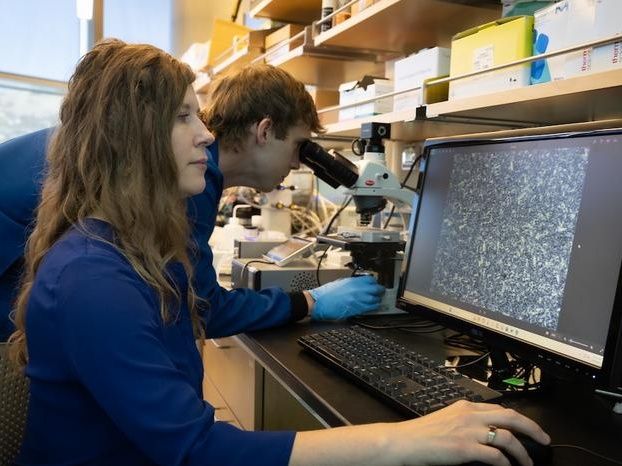
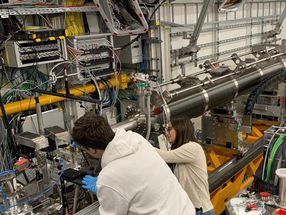
Jessica Kramer, left, and Thomas McParlton observe the size of ice crystals in a sample treated with their protein in their lab at the University of Utah.
Dan Hixson, University of Utah
The antifreeze in your car — ethylene glycol — is toxic, so it isn’t a solution for foods or drugs. Instead, researchers have turned to nature for inspiration: fish that inhabit polar waters have proteins in their blood that prevent it from freezing.
Now, researchers from the University of Utah’s John and Marcia Price College of Engineering have devised a way to make a stripped-down, synthetic version of that protein, simple enough to be manufactured at scale, but powerful enough to inhibit the formation of ice crystals at sub-zero temperatures.
The researchers demonstrated the effectiveness of their mimic polypeptides on several real-word test cases, including ice cream and the anti-cancer drug Trastuzumab. The former was successfully chilled down to minus 4 degrees Fahrenheit, while the latter survived temperatures as low as minus 323 degrees F.
The study, funded by the National Science Foundation, was published in the journal Advanced Materials. It was led by Jessica Kramer, an associate professor in the Department of Biomedical Engineering, and Thomas McParlton, a graduate student in her lab.
For decades, researchers have eyed the naturally occurring antifreeze proteins found in certain polar fish, as well as some insects and plants. However, extracting meaningful quantities of these proteins from living organisms is impractical for commercial use. The are also suscepctible to contamination with allergens.
Kramer and her colleagues therefore set out to determine the exact physical and chemical properties of these proteins that were responsible for their antifreeze capabilities. A pair of earlier studies, published in Chemistry of Materials and Biomacromolecules, demonstrated the structural features that were most critical in the naturally occurring proteins.
“Ultimately, we simplified the structure to only the parts we thought were required for antifreeze activity, which makes production less complicated and expensive,” Kramer said. “Despite those changes, this study showed that our mimics bind to the surface of ice crystals and inhibit crystal growth, just like natural antifreeze proteins.”
“Best of all,” McParlton said, “we make these mimics entirely using chemistry — no fish or cells required.”
As proof of concept, the researchers demonstrated that the mimic molecules are non-toxic to human cells, are digestible by enzymes of the human gut, and can survive heating, a critical factor for its potential for food production. They also ran tests on sensitive enzymes and antibodies, showing that the mimics protected them from damage associated with freeze/thaw cycles.
“We also showed that we can inhibit ice crystals in ice cream, which often happens during shipping or when people take the carton in and out of the freezer,” Kramer said.
The researchers envision their mimic molecules enabling a wide variety of applications, from extending the shelf life of frozen foods to improving the storage and transport of life-saving biologics. The technology is currently patent pending, and the team is working to bring their innovation to market through a new startup company, Lontra Bio LLC, which aims to commercialize these synthetic antifreeze proteins.
Original publication
Other news from the department science







Most read news



More news from our other portals














Something is happening in the life science industry ...
This is what true pioneering spirit looks like: Plenty of innovative start-ups are bringing fresh ideas, lifeblood and entrepreneurial spirit to change tomorrow's world for the better. Immerse yourself in the world of these young companies and take the opportunity to get in touch with the founders.
Last viewed contents

AI models for drug design fail in physics

Targeted protein degradation: Researchers find new way to combat harmful proteins in tumour cells - Domino effect in the fight against cancer
Chemistry meets biology: controlling artificial cell membranes through catalysis - Researchers develop an artificial metalloenzyme-based platform that enables programmable control of artificial membrane behavior

QIAGEN to acquire Parse Biosciences - Entering the age of single-cell AI

Setting the Course for AI-Assisted Radiology - Fraunhofer MEVIS and Radboud University Medical Center have founded the spin-off Plain Medical
Ancient viral DNA shapes modern human placentas - “It’s a reminder that there is much more to learn about our genome and how ancient infections can influence who we are today”
Analytica 2026: AI as a driver of digital transformation - Laboratory of the future in action

How the principle of cheese noodles helps against Alzheimer's
New deep-learning tool can tell if your salmon is wild or farmed

Bayer confirms 2025 Group outlook, progresses on strategic priorities - "Our organization continues to get leaner and more efficient, and we’re seeing benefits in terms of speed and focus"

Q3 2025: Merck Shows Solid Organic Growth Across All Sectors - Strong performance by Process Solutions, Rare Diseases and Semiconductor Solutions