Actin Scaffold in Cell Nucleus Explains Survival of Cancer Cells
Protective mechanism helps cancer cells to avoid dying during their migration in the body: In the long term, targeted interventions in this mechanism could help to prevent metastases
Advertisement


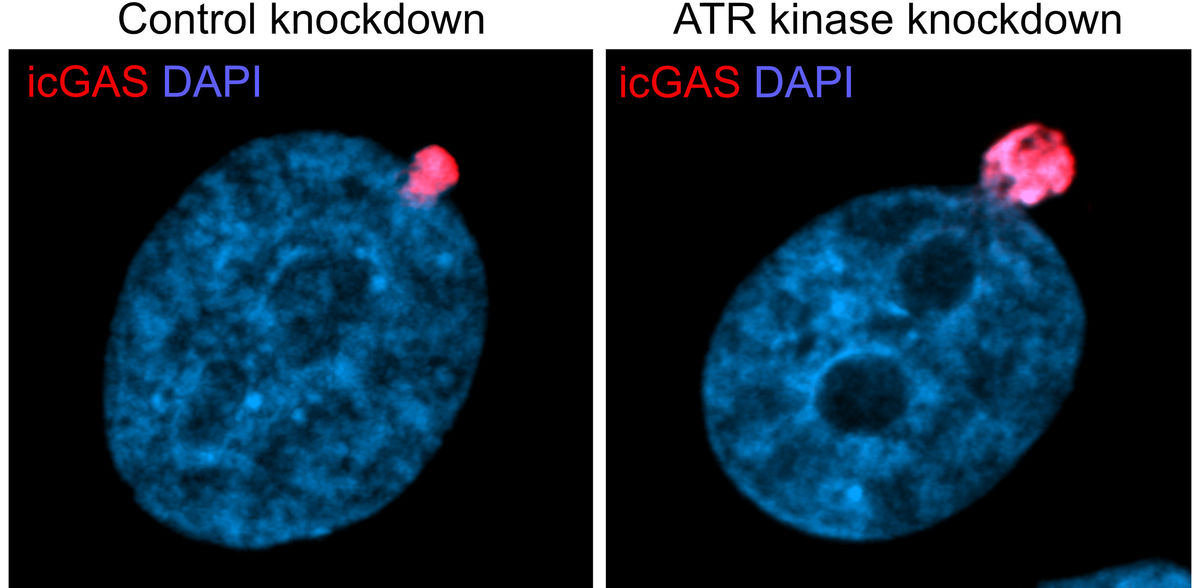
cancer cells are subjected to high mechanical pressure that leads to a rupture of the nuclear envelope when migrating through narrow tissue structures, as in the case of metastasis. DNA would normally leak out in the process, causing damage to the cell. However, researchers at the University of Freiburg’s Cluster of Excellence CIBSS - Centre for Integrative Biological Signalling Studies succeeded in demonstrating that a protective mechanism takes effect at this moment. A fine scaffold of actin filaments forms in the cell nucleus within seconds. The protein actin is a fundamental component of the cell structure. Driven by the proteins DIAPH1 and DIAPH3 and the DNA damage sensor protein ATR, this scaffold stabilizes the nucleus and prevents DNA loss. ‘This protective mechanism provides an explanation for why cancer cells do not die despite high mechanical stress but can continue their migration’, says Prof. Dr. Robert Grosse, Institute of Experimental and Clinical Pharmacology and Toxicology of the University of Freiburg. The study was published in The EMBO Journal.
High-performance microscopy and cell tests
For the study, the researchers deployed a highly invasive cancer cell line (fibrosarcoma cells, HT1080) in special microchannels of three or eight micrometres. The narrow passage in particular caused core ruptures. Actin filaments formed within about 80 seconds of such a rupture. The team measured the mechanical properties of the cell nucleus using the method of atomic force microscopy. Together with Prof. Dr. Pitter Huesgen, a collaboration partner in the Cluster of Excellence CIBSS, the researchers worked out how ATR passes on signals to DIAPH3 to trigger the formation of actin filaments.
Significance for metastases and therapeutic approaches
The researchers were able to demonstrate that the proteins DIAPH1 and DIAPH3 and the DNA damage sensor protein ATR are crucial for the protective mechanism. When the scientists blocked this mechanism, the cell nucleus became unstable, and more DNA leaked out. ‘In the long term, targeted interventions in the ATR-formin axis could be used to inhibit this protective mechanism. That could prevent the formation of metastases or help treat diseases involving unstable cell nuclei’, says Grosse.
Original publication
Other news from the department science











Most read news




More news from our other portals
















Last viewed contents

AI models for drug design fail in physics

Targeted protein degradation: Researchers find new way to combat harmful proteins in tumour cells - Domino effect in the fight against cancer
Chemistry meets biology: controlling artificial cell membranes through catalysis - Researchers develop an artificial metalloenzyme-based platform that enables programmable control of artificial membrane behavior

QIAGEN to acquire Parse Biosciences - Entering the age of single-cell AI

Setting the Course for AI-Assisted Radiology - Fraunhofer MEVIS and Radboud University Medical Center have founded the spin-off Plain Medical
Ancient viral DNA shapes modern human placentas - “It’s a reminder that there is much more to learn about our genome and how ancient infections can influence who we are today”

Analytica 2026: AI as a driver of digital transformation - Laboratory of the future in action
How the principle of cheese noodles helps against Alzheimer's

New deep-learning tool can tell if your salmon is wild or farmed

Bayer confirms 2025 Group outlook, progresses on strategic priorities - "Our organization continues to get leaner and more efficient, and we’re seeing benefits in terms of speed and focus"

Q3 2025: Merck Shows Solid Organic Growth Across All Sectors - Strong performance by Process Solutions, Rare Diseases and Semiconductor Solutions