Chemistry meets biology: controlling artificial cell membranes through catalysis
Researchers develop an artificial metalloenzyme-based platform that enables programmable control of artificial membrane behavior
Advertisement


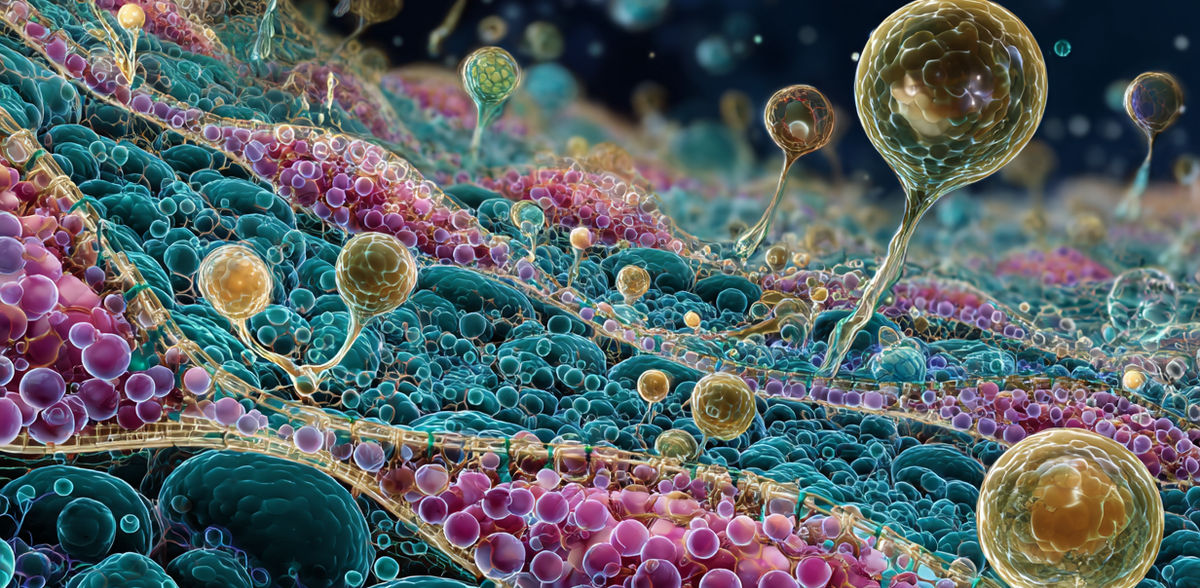
Using catalytic chemistry, researchers at Institute of Science Tokyo have achieved dynamic control of artificial membranes, enabling life-like membrane behavior. By employing an artificial metalloenzyme that performs a ring-closing metathesis reaction, the team induced the disappearance of phase-separated domains as well as membrane division in artificial membranes, imitating the dynamic behavior of natural biological membranes. This transformative research marks a milestone in synthetic cell technologies, paving the way for innovative therapeutic breakthroughs.
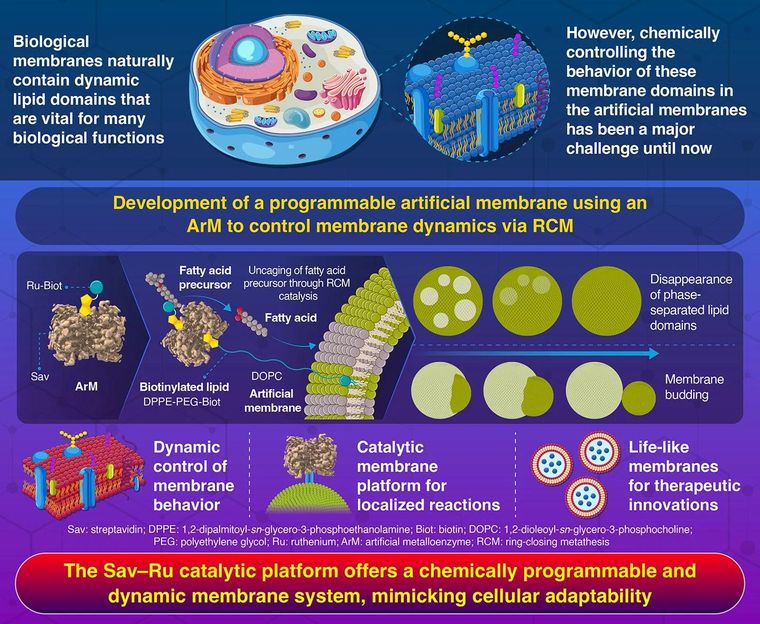
Programmable Artificial Cell Membranes Controlled by a Catalytic Chemical Reaction
Biological membranes are fundamental structures that form boundaries of all living cells, controlling how cells communicate, grow, and respond to their environment. These membranes are composed of different molecules, such as lipids and proteins, which organize themselves into a membrane layer. Under certain circumstances, the molecules cluster together into local functional regions that regulate specific biological processes. These clustered regions are known as phase-separated domains and are distinct from the surrounding membrane.
Understanding and replicating the dynamic behaviors of these regions has long fascinated scientists aiming to construct artificial cells that behave like natural cells. However, since most artificial membrane models remain static, reproducing these adaptive properties of biological membranes has remained a major challenge until now. Addressing this challenge, researchers at Institute of Science Tokyo (Science Tokyo), Japan, and the University of Basel, Switzerland, jointly developed a new chemical strategy to control the behavior of artificial cell membranes.
The study was led by Professor Kazushi Kinbara and doctoral student Rei Hamaguchi from the School of Life Science and Technology, Science Tokyo, Japan, in collaboration with Professor Thomas R. Ward from the University of Basel, Switzerland. The findings were made available online on October 15, 2025, and were published in Volume 147, Issue 43 of the Journal of the American Chemical Society on October 29, 2025.
To bring the membranes to life, the researchers first built tiny artificial cell-like structures called lipid vesicles. The researchers then built a hybrid catalyst known as an artificial metalloenzyme (ArM)—a combination of a biological protein streptavidin (Sav) and a synthetic metal catalyst (ruthenium metal complex) carrying a biotin (vitamin B7) moiety. This enzyme acts like a catalyst on the membrane, performing a critical chemical reaction known as ring-closing metathesis (RCM).
To attach the ArM catalyst to the surface of the lipid membrane, the team also incorporated a special kind of biotin-tagged lipid into the membrane, which acted as an anchor for the catalyst.
“When triggered by fatty acid precursors, the ArM system releases free fatty acids through RCM,” explains Kinbara. “These fatty acids slip into the membrane, subtly altering its structure and driving dynamic membrane behavior.”
Molecular simulations revealed key mechanisms underlying these transformations. Inactive, caged fatty acid precursors were first activated by the ArM catalyst through the RCM reaction. This reaction uncages the caged fatty acid precursors, releasing free fatty acids near the membrane. The released fatty acids naturally insert themselves into the membrane surface, changing its rigidity and curvature, which in turn leads to visible transformations such as the disappearance of phase-separated domains and membrane division.
“It’s a bit like giving a synthetic membrane the ability to breathe and respond,” says Kinbara. “By controlling a chemical reaction on the membrane’s surface, we can make it reorganize itself, much like a living cell does.”
The discovery marks the first attempt to chemically program the physical behavior of artificial membranes, setting the stage for the creation of life-like materials that can sense and respond to their surroundings. It not only advances synthetic biology but also introduces a blueprint for creating programmable artificial membranes that could inspire future therapeutic innovations—bridging the gap between chemistry and life.
Original publication
Other news from the department science















Most read news




More news from our other portals

















Last viewed contents

QIAGEN to acquire Parse Biosciences - Entering the age of single-cell AI

Setting the Course for AI-Assisted Radiology - Fraunhofer MEVIS and Radboud University Medical Center have founded the spin-off Plain Medical

Ancient viral DNA shapes modern human placentas - “It’s a reminder that there is much more to learn about our genome and how ancient infections can influence who we are today”

Analytica 2026: AI as a driver of digital transformation - Laboratory of the future in action

How the principle of cheese noodles helps against Alzheimer's

New deep-learning tool can tell if your salmon is wild or farmed

Bayer confirms 2025 Group outlook, progresses on strategic priorities - "Our organization continues to get leaner and more efficient, and we’re seeing benefits in terms of speed and focus"

Q3 2025: Merck Shows Solid Organic Growth Across All Sectors - Strong performance by Process Solutions, Rare Diseases and Semiconductor Solutions

REVY Environmental Solutions: From ISC3 Start-up of the Month to Pioneer in Resource Recovery from Waste - Sustainable Chemistry Changemakers: Paving the Way Toward a More Sustainable Future

PeptiSystems secures growth equity investment from Rubicon Healthcare Partners

Grenova acquires Peak Robotics - The combined organization will continue advancing Grenova’s mission to transform laboratory operations through innovation, sustainability, and intelligent design