New deep-learning tool can tell if your salmon is wild or farmed
Advertisement


A new paper in Biology Methods and Protocols, published by Oxford University Press, finds that we can now distinguish wild from farmed salmon using deep learning, potentially greatly improving strategies for environmental protection.
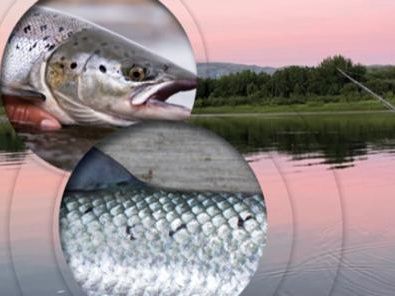
A single salmon scale can reveal a great deal about the fish’s life. As the salmon grows, its scales form concentric rings whose number and spacing reflect its body growth over time.
Eva Setsaas, Eva Thorstad, and Bengt Finstad/ Biology Methods and Protocols
Norway is home to the largest remaining wild populations of wild salmon and is also one of the largest producers of farmed salmon. Atlantic salmon abundance in Norway has declined by over 50% since the 1980s and is now at historically low levels. Escaped farmed salmon are an important reason for this decline. Norway produces over 1.5 million metric tons of farmed Atlantic salmon annually. Each year, however, approximately 300,000 farmed salmon escape into the wild.
Escaped salmon are a substantial ecological and genetic threat to wild populations since they increase competition for limited resources, such as food and spawning habitats, potentially displacing wild salmon or reducing their reproductive success. Farmed salmon also introduce pathogens and parasites such as sea lice, worsening pressures on wild salmon populations already vulnerable due to climate change and habitat degradation.

Farmed salmon differ genetically from wild populations and interbreeding between escaped farmed salmon and wild salmon leads to genetic changes that make wild salmon less fit to adapt to environmental changes or address threats around them. Genetic analysis shows that approximately two-thirds of wild salmon in Norway carry genetic signatures that indicate interbreeding with farmed salmon.
Scientists monitor escaped farmed salmon using genetic analysis and examination of fish scales. Monitoring differences in fish scale patterns by hand is time consuming and extremely expensive, however. Investigators can distinguish wild from farmed salmon because salmon scales grow by forming concentric rings on their surface. Like with tree rings, the number and spacing of these rings correspond to the growth of the fish. Farmed salmon have scales that represent rapid and steady growth, resulting in regularly spaced scales with limited seasonal markers. In contrast, wild salmon experience pronounced seasonal variation in growth driven by inconsistent temperatures, prey availability, and migration.
To help researchers distinguish between different types of salmon at a larger scale, researchers here trained a new convolutional neural network using nearly 90,000 Atlantic salmon scale images from the Norwegian Veterinary Institute and the Norwegian Institute for Nature Research. They established a standardized processing pipeline and evaluated the model against human scale readers and known-origin fish.
The total dataset consisted of almost 90 thousand images, covering hundreds of rivers across Norway and going back to the early 1930s. Farmed salmon comprised approximately 8.5% of the total images compared to wild salmon.
The investigators found that the data pipeline and model can rapidly process images and provide predictions with associated confidence estimates. The model performed exceptionally well, and was able differentiate farmed from wild salmon across most salmon rivers in Norway from 2009 to 2023 with 95% accuracy.
Original publication
Malte Willmes, Anders Varmann Aamodt, Børge Solli Andreassen, Lina Victoria Tuddenham Haug, Enghild Steinkjer, Gunnel M Østborg, Gitte Løkeberg, Peder Fiske, Geir R Brandt, Terje Mikalsen, Arne Siversten, Magnus Moustache, June Larsen Ydsti, Bjørn Florø-Larsen; "Identifying escaped farmed salmon from fish scales using deep learning"; Biology Methods and Protocols, Volume 10, 2025-11-26

Other news from the department science










Most read news




More news from our other portals

















Last viewed contents

Bayer confirms 2025 Group outlook, progresses on strategic priorities - "Our organization continues to get leaner and more efficient, and we’re seeing benefits in terms of speed and focus"

Q3 2025: Merck Shows Solid Organic Growth Across All Sectors - Strong performance by Process Solutions, Rare Diseases and Semiconductor Solutions

REVY Environmental Solutions: From ISC3 Start-up of the Month to Pioneer in Resource Recovery from Waste - Sustainable Chemistry Changemakers: Paving the Way Toward a More Sustainable Future

PeptiSystems secures growth equity investment from Rubicon Healthcare Partners

Grenova acquires Peak Robotics - The combined organization will continue advancing Grenova’s mission to transform laboratory operations through innovation, sustainability, and intelligent design

Captain T Cell Closes Financing Round to Advance its Proprietary, Next-Generation TCR-T Pipeline Into the Clinic - Developing novel solid tumor treatments addressing a high unmet medical need

How a gene shapes the architecture of the human brain
NLRP3 drives chronic blood cancer - In certain blood cancers, inflammatory processes in the bone marrow lead to life-threatening scarring

Building materials from mushrooms - 20 million euros for fungal biotechnology and spatial sociology

Experimental mRNA therapy shows potential to combat antibiotic-resistant infections - Lipid nanoparticle delivery system carries instructions for antimicrobial peptibodies

Aging alters the protein landscape in the brain – diet can counteract this - "Our results show that even in old age, diet can still have an important influence on molecular processes in the brain"