Simply taste your way to flu infection
Rapid test for influenza viruses using chewing gum – without the need for a laboratory, electricity or medical personnel

Advertisement


Detect influenza viruses quickly and easily with chewing gum or a lollipop: researchers from Würzburg, Braunschweig and Cologne demonstrate with a new diagnostic tool how this works.
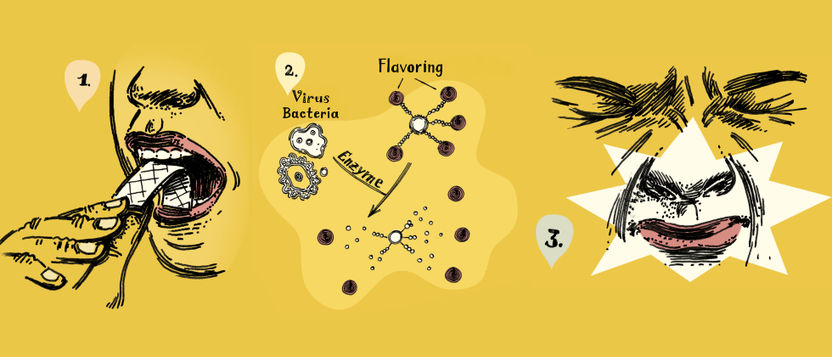
How the flu sensor works: 1. An infected or sick person chews gum. 2. Enzymes in the virus release the flavourings contained in the gum. 3. The person perceives the substances and recognises the infection.
Christoph Mett
Influenza is much more than just a nasty cold – it is one of the most dangerous infectious diseases worldwide, claiming around half a million lives every year.
What makes it particularly insidious is that flu viruses are contagious even before the first symptoms appear. Despite this threat, the diagnostic options available to date are far from ideal. They are often expensive, complicated to use and simply unavailable in many poorer regions of the world.

A research team led by Professor Lorenz Meinel from the University of Würzburg has developed the technology behind a new self-test for influenza, recently published in ACS Central Science.
Detecting Flu Infections Quickly and Easily
The new principle could make flu diagnosis quicker, cheaper and easier in the future. Anyone could use it anytime, anywhere, for example in the form of chewing gum or a lollipop that reacts to flu viruses in the saliva of infected people and releases a flavouring. In the mouths of non-infected individuals, however, nothing would happen. This would allow those affected to detect an infection within minutes – without the need for a laboratory, electricity or medical personnel.
‘This strategy opens up new possibilities for the early detection and control of influenza worldwide,’ says Lorenz Meinel, who heads the Chair of Drug Formulation and Delivery at the University of Würzburg.
Flavouring Plus Virus-specific Building Block
The new diagnostic tool consists of the sensor molecule thymol – a natural substance found in thyme, among other things – and a virus-specific sugar building block. When it comes into contact with active influenza viruses, these release the thymol, creating a clearly recognisable taste in the mouth.
‘Instead of relying on expensive and complicated testing procedures, we use the natural human sensory system – taste – as a tool for the early detection of infections,’ says Lorenz Meinel.
The principle is flexible: both the flavour carrier and the recognition component can be adapted. For example, the system can be equipped with sweet, bitter or salty flavours – even child-friendly ones. It can also be transferred to different pathogens.
‘For other infections, for example, the virus-specific sugar component could be replaced by a bacteria-specific peptide. The underlying functionality would remain the same,’ explains Lorenz Meinel. The method thus opens up new possibilities for low-threshold diagnostics of viral and bacterial infections – from influenza to future pathogens that are not yet known today.
Next Step: Developing Specific Applications
The researchers are now working on incorporating the sensors into chewing gum or lollipops and making the diagnostic system suitable for mass production. To this end, it is collaborating with FlareOn Biotech GmbH, a start-up founded in 2024 by the University of Würzburg. The development process is expected to take around four years.
The team is convinced that such applications are particularly suitable for critical locations such as schools, nurseries and retirement homes. They could be of crucial importance in containing outbreaks of infection, especially in poorer countries.
Long-term Goal: Tracking the Spread of Influenza in Real Time
The researchers are already thinking further ahead: As soon as an application is available, they would like to ask all users to voluntarily record positive influenza test results using a smartphone app. This data could provide a previously unattainable online overview of the situation, enabling the spread of influenza viruses to be tracked in real time.
Artificial intelligence could then also be used to predict where epidemics or pandemics might develop. This would enable the World Health Organisation, governments, local authorities and even individuals to take precautionary measures at an early stage.
Original publication
Martina Raschig, Marcus Gutmann, Josef Kehrein, Eberhard Heller, Michael Bomblies, Marcel Groß, Oskar Steinlein, Peggy Riese, Stephanie Trittel, Tessa Lühmann, Carlos A. Guzmán, Jürgen Seibel, Heinrich Jehle, Christian Linz, Stephan Hackenberg, Lorenz Meinel; "A Viral Neuraminidase-Specific Sensor for Taste-Based Detection of Influenza"; ACS Central Science, 2025-10-1

Other news from the department science














Most read news





More news from our other portals


















Something is happening in the life science industry ...
This is what true pioneering spirit looks like: Plenty of innovative start-ups are bringing fresh ideas, lifeblood and entrepreneurial spirit to change tomorrow's world for the better. Immerse yourself in the world of these young companies and take the opportunity to get in touch with the founders.
See the theme worlds for related content
Topic world Diagnostics
Diagnostics is at the heart of modern medicine and forms a crucial interface between research and patient care in the biotech and pharmaceutical industries. It not only enables early detection and monitoring of disease, but also plays a central role in individualized medicine by enabling targeted therapies based on an individual's genetic and molecular signature.

Topic world Diagnostics
Diagnostics is at the heart of modern medicine and forms a crucial interface between research and patient care in the biotech and pharmaceutical industries. It not only enables early detection and monitoring of disease, but also plays a central role in individualized medicine by enabling targeted therapies based on an individual's genetic and molecular signature.
Last viewed contents

Transparent artificial intelligence improves assessment of prostate cancer aggressiveness - AI speaks the language of pathologists
New nanosensors make diagnostic procedures more sensitive - The nanosensors can be used to track reactions with invisible light, saving materials and time

Cyber Valley grants 500K to CELL’n’ROLL via 2023 Innovation Fellowship Program - Cyber Valley Community is advancing diagnostics for the future: Its goal is to create an innovative spin-off from the project after the funding term has ended
Blood diagnostics modelled on leeches - For all those who are afraid of needles: New device for taking blood samples uses microneedles and a suction cup instead of a large needle
AI personalises brain tumour therapy - Progress in the personalised treatment of brain tumours: AI identifies mutations

En Carta Diagnostics secures €1.5M to advance diagnostic kit platform for early Lyme disease detection - Groundbreaking patented molecular diagnostic kit poised to provide game-changing autonomous Lyme detection in minutes

Portable AI-based test kit to identify bacterial infections - Dutch scientist selected as a finalist for the Young Inventors Prize 2024: Her startup focuses on the most common types of infection

Altona Diagnostics announces leadership transition - New General Managers appointed
Silk sponges instead of animal testing - How a 3D cell culture system could revolutionize cancer diagnostics
Next-generation sequencing: NGS-based diagnostics for identifying sepsis pathogens wins EARTO Innovation Award
Novel Technique Improves Brain-State Detection - New method boosts precision of a non-invasive brain-state classification with functional near-infrared spectroscopy (fNIRS)