Small molecules, big impact: Polyamines promote regeneration in aged intestines
By specifically activating polyamine metabolism prior to injury, the researchers were able to restore the regenerative capacity of aged intestinal cells in a mouse model
Advertisement


The intestine is among the most regenerative tissues in the body; however, aging triggers various changes that collectively diminish its regenerative capacity. Consequently, the intestine becomes more vulnerable to inflammation and infection, and its healing processes slow down. This often leads to digestive problems and delayed recovery after long-term medication use in older individuals. The underlying cause is the reduced ability of the intestinal epithelium to efficiently repair itself after damage. But why does the intestine lose this regenerative potential with age—and can the process be reversed?
An international team of researchers from Germany, Italy, and the US led by Dr. Alessandro Ori and Prof. Francesco Neri, former research group leaders at the Leibniz Institute on Aging – Fritz Lipmann Institute (FLI) in Jena, have investigated these questions in a study now published in Nature Cell Biology.
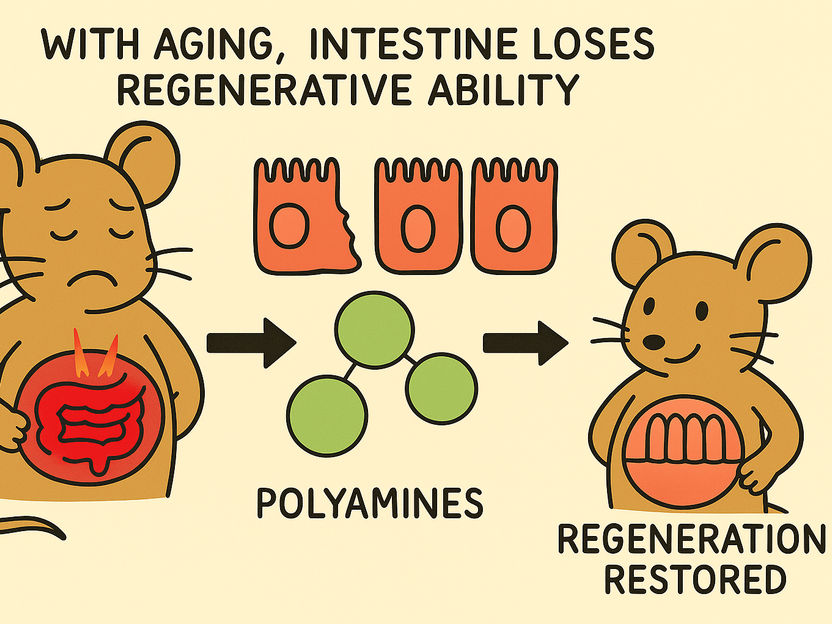
Aging reduces small-intestinal regeneration through proteostasis defects and protein buildup. Elevating polyamine levels before injury improves proteostasis and boosts cell proliferation, enhancing intestinal repair.
FLI / Alberto Minetti; AI-generated with ChatGPT
Aging gut out of balance
The researchers found that during the regeneration of aged mice’s small intestines, the protein homeostasis (proteostasis) balance—the fine equilibrium between protein synthesis, folding and degradation—becomes disrupted. As a result, old intestinal cells accumulate faulty, or “defective,” proteins while attempting to repair tissue damage. This accumulation triggers cellular stress, which in turn hampers the cells’ ability to regenerate effectively.
"By analyzing proteins and metabolites in intestinal tissue and conducting experiments to show how the intestine recovers after damage caused by 5-fluorouracil (a chemotherapy drug), we were able to determine that the reduced regenerative capacity of older intestinal cells is not an unavoidable effect of aging. Rather, it is directly related to a disruption in proteostasis," explains Dr. Ori.
Polyamines as the key to regeneration
A comparison of the regenerative capacity in young and old mice showed that, after damage, typical signs of proteostasis stress and elevated polyamine levels were observed only in the aged intestine. Polyamines, such as spermidine and putrescine, are small, positively charged molecules involved in many cellular processes, including both cell growth, proliferation and proteostasis regulation.
In the experiments, it was found that old mice increased polyamine levels specifically after intestinal damage, likely to improve protein homeostasis and counteract the damage that had occurred. “When polyamine metabolism is activated, for example through dietary interventions or direct oral supplementation, protein homeostasis ameliorates, and the regeneration of the intestinal epithelium is accelerated again,” report Dr. Alberto Minetti and Dr. Omid Omrani, main researchers involved in the study. “Our data suggest that the aging intestine remains capable of repair at the molecular level, it just needs the right molecular trigger to kick-start its regenerative capacity again.”
Nutrition and polyamines as a new therapeutic approach?
Particularly exciting is the finding that a short period of dietary restriction followed by two days of re-feeding, or direct polyamine supplementation, can activate polyamine metabolism prior to injury and restore regenerative capacity in aged mice. In contrast, intestinal regeneration worsened significantly when this metabolic pathway was specifically blocked.
This discovery could have far-reaching implications: polyamines, or a polyamine-rich diet, may enhance intestinal regeneration in older individuals following surgery, infection, or chemotherapy. Moreover, similar mechanisms could potentially apply to other aging tissues such as the skin or liver, opening new avenues to counteract age-related functional decline.
“We see this as a promising approach to reactivating the body's self-healing powers in old age,” explains Prof. Francesco Neri from the University of Turin. “Polyamines act as molecular regulators that help restore balance to the cell’s machinery.”
Prospects for aging research
As a next step, it will be important to carefully evaluate the safety and potential benefits of activating the polyamine pathway to enhance tissue regeneration, while also assessing possible risks such as increased cancer susceptibility. If so, targeted dietary or pharmacological polyamine interventions could help treat or even prevent age-related tissue damage in the future.
“Aging is not an irreversible process,” summarizes Dr. Ori. "If we understand how cells lose their balance – and how we can restore it – we may not be able to stop aging, but we can significantly mitigate its effects on our bodies.
Original publication
Alberto Minetti, Omid Omrani, Christiane Brenner, Feyza Cansiz, Shinya Imada, Jonas Rösler, Saleh Khawaled, Gabriele Allies, Sven W. Meckelmann, Nadja Gebert, Ivonne Heinze, Norman Rahnis, Jing Lu, Katrin Spengler, Mahdi Rasa, Emilio Cirri, Regine Heller, Ömer Yilmaz, Alpaslan Tasdogan, Francesco Neri, Alessandro Ori; "Polyamines sustain epithelial regeneration in aged intestines by modulating protein homeostasis"; Nature Cell Biology, 2025-11-24
Other news from the department science






Most read news



More news from our other portals













Last viewed contents
From beer to useful fats and medicines - The spent grain from beer brewing can be used to make microcapsules that can preserve omega-3 oils and medicines
AI models for drug design fail in physics

Targeted protein degradation: Researchers find new way to combat harmful proteins in tumour cells - Domino effect in the fight against cancer
Chemistry meets biology: controlling artificial cell membranes through catalysis - Researchers develop an artificial metalloenzyme-based platform that enables programmable control of artificial membrane behavior

QIAGEN to acquire Parse Biosciences - Entering the age of single-cell AI
Setting the Course for AI-Assisted Radiology - Fraunhofer MEVIS and Radboud University Medical Center have founded the spin-off Plain Medical
Ancient viral DNA shapes modern human placentas - “It’s a reminder that there is much more to learn about our genome and how ancient infections can influence who we are today”
Analytica 2026: AI as a driver of digital transformation - Laboratory of the future in action
How the principle of cheese noodles helps against Alzheimer's
New deep-learning tool can tell if your salmon is wild or farmed
Bayer confirms 2025 Group outlook, progresses on strategic priorities - "Our organization continues to get leaner and more efficient, and we’re seeing benefits in terms of speed and focus"