TUM spin-off: Using artificial intelligence to track proteins
Advertisement


Faster, better, and ideally tailored to each individual: the medicine of the future aims to deliver precise diagnoses and treatment plans. The interaction of proteins plays a key role in this. To understand this interplay, large, high-quality datasets must be analyzed as efficiently as possible. MSAID, a spin-off of the Technical University of Munich (TUM), has developed AI-powered software that can do this even for complex samples.
Some ideas won’t let go. That was the case for a team at Professor Bernhard Küsters Chair of Proteomics and Bioanalytics at TUM. Building on a research project, the scientists developed a software prototype to determine which proteins are present in a sample, when and in what quantities they appear, and what they do. Gaining a better understanding of these processes could enable medical breakthroughs in diagnosing and treating disease.
“Our prototype already outperformed existing approaches in both the quality and quantity of proteins identified. We were determined to push this development forward and make it accessible to researchers and institutions worldwide,” says Mathias Wilhelm, Professor of Computational mass spectrometry at the TUM School of Life Sciences. Mathias Wilhelm and Bernhard Küster already had founded a company together and decided to take the leap again. Together with Martin Frejno, Daniel Zolg, Siegfried Gessulat, and Tobias Schmidt, they founded MSAID in 2019, a startup specializing in deep-learning models for protein research. All founders have studied, earned their doctorates, or worked at TUM.
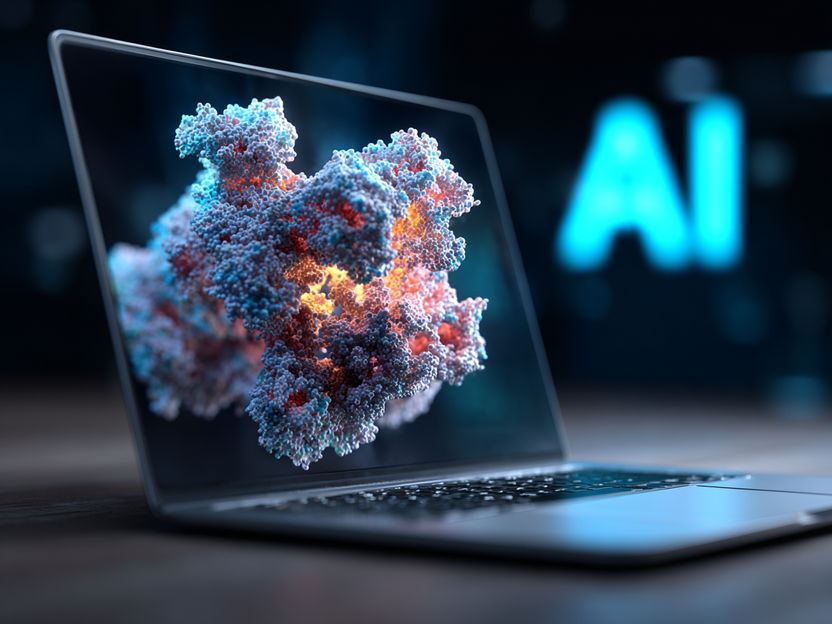
Symbolic image
AI-generated image
A database for AI-generated molecular “fingerprints”
Since 2022, MSAID has been marketing a patented successor of the software whose prototype sparked the company’s founding. It streamlines the analysis of complex, large datasets. MSAID COO Daniel Zolg compares the approach to fingerprint identification: “Every protein consists of different peptides, each with its own specific fingerprint. We can make the fingerprints in a sample visible using a mass spectrometer. But the quality of these fingerprints isn’t always good—often you only have a partial print of a peptide, and sometimes they even overlap. That makes it harder to tell which measurement corresponds to which peptide. It’s a bit like trying to analyze fingerprints on a doorknob that’s been touched by many different people.”
Manually analyzing such large amounts of data is no longer possible. After all, humans are made up of more than 20,000 different proteins. The founders therefore leverage AI’s strengths in pattern simulation: an algorithm compares the measurement results with a kind of “peptide database” containing AI-generated patterns created by the team. These patterns match those produced by peptides during mass-spectrometry-based analysis. And more: they can even be used to predict what patterns will emerge when different peptides overlap.
“Using our approach, we can substantially improve protein identification in complex samples like tissue and plasma, better quantify their amounts, and reduce manual steps. Our software also enables analyses that would otherwise take several weeks to be completed in just a few days,” says MSAID CEO Martin Frejno. “That opens new avenues for early disease detection, personalized medicine, and drug development.”
Other news from the department science







Most read news



More news from our other portals














Something is happening in the life science industry ...
This is what true pioneering spirit looks like: Plenty of innovative start-ups are bringing fresh ideas, lifeblood and entrepreneurial spirit to change tomorrow's world for the better. Immerse yourself in the world of these young companies and take the opportunity to get in touch with the founders.
See the theme worlds for related content
Topic World Mass Spectrometry
Mass spectrometry enables us to detect and identify molecules and reveal their structure. Whether in chemistry, biochemistry or forensics - mass spectrometry opens up unexpected insights into the composition of our world. Immerse yourself in the fascinating world of mass spectrometry!

Topic World Mass Spectrometry
Mass spectrometry enables us to detect and identify molecules and reveal their structure. Whether in chemistry, biochemistry or forensics - mass spectrometry opens up unexpected insights into the composition of our world. Immerse yourself in the fascinating world of mass spectrometry!
Last viewed contents

Gentle protein purification at the touch of a button - i3 Membrane revolutionizes the separation of biological agents
Bio-based plastics for infusion bags - Frankfurt research team develops sustainable alternative to medical products made from crude oil in cooperation with bioplastics start-up BIOVOX

Recipharm secures major additional grant to develop AI-enabled manufacturing technologies - Development of an AI-enabled simulator and process control platform, to speed up process development, cut costs and improve manufacturing efficiency
Merck Partners with Promega Corporation

Berlin is set to become a hotspot for the development of innovative therapies - More than just a ground-breaking ceremony: start of construction for the Berlin Center for Gene and Cell Therapies
Kerry Establishes New Biotechnology Centre in Leipzig - Centre to facilitate cutting-edge innovations with wide range of applications across food, beverage and pharma
Laboratory innovations and expert knowledge at analytica 2026 - Key topics: digitalization, automation, sustainability

BASF and IFF announce strategic collaboration to drive next-generation enzyme and polymer innovation

Smartbax secures 4.7 million euros in Pre-Series A funding for the further development of a novel antibiotic up to preclinical stage - Lead candidate against a novel target in Gram-negative bacteria has already been validated in infection models
FIRST LABS - Laboratory start-up support for start-ups - The Rock Capital Group is expanding its concept of ready-to-use laboratories in the life science hub at SKYGATE in Hallbergmoos, especially for start-ups and smaller companies

From beer to useful fats and medicines - The spent grain from beer brewing can be used to make microcapsules that can preserve omega-3 oils and medicines